“If there had been some tiny bead present in the brain of all humans, that had told each other, They are like you; that had drawn some thin silk thread of empathy, person to person, in a planet-wide net – what might then have happened? Would there have been the same wars, massacres, persecutions and crusades?”
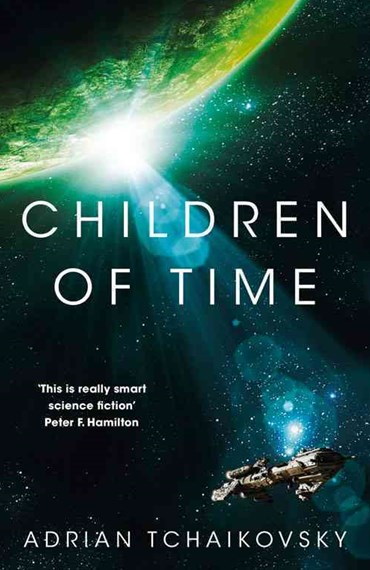
I bought this book immediately after reading Elder Race (If you haven’t read it, I highly recommend it), having fallen in love with Adrian Tchaikovsky’s flavor of sci-fi. Children of Time was not what I expected, but I was not disappointed in the slightest.
This book has the classic sci-fi set up of humans messing up the earth to the point that they need to branch out in search of other worlds to colonize. (I feel like this set up is used a lot, but to be fair it’s probably pretty accurate to what would happen in real life. lol)
One of the planets found in this search is a planet that was previously terraformed and seeded with life by the Old Empire. Still pretty standard sci-fi stuff, but this is where Adrian Tchaikovsky throws a curveball. The seeding of the planet had gone wrong and the released virus which was supposed to help accelerate the evolution of monkeys has instead taken root in spiders. Boom, mind blown. I am not a fan of spiders in the slightest, but I loved reading about the evolutions and technology advances of a society that was built by spiders. It was just crazy to me the way that Adrain molded and shaped this spider society. I think it is clear that he studied spiders and progressed his spider society in a way that felt possible and “accurate” given such an outlandish situation. When it came to how the spiders communicate, travel, or work through problems you sit there going, “huh, I never thought of it that way, but I guess that is how a spider would do it”. In the end, the way that Adrian was able to bring a concept so alien like an advanced spider society into a realm that seemed believable was quite a joy to read.
Another thing that was interesting about the book is how Adrain decided to deal with time. Since the book takes place over generations of humans and spiders Adrian has a cool way of making you feel like you’re staying with the same characters. On the human side I’m sure you’re all thinking the same thing, cryo-stasis, sleep chambers, or something like that and you would be right. Over the years we stay with the same group of human characters stretched through time with the use of sleep chambers. We get to watch some characters jump through time staying relatively the same age the whole book while others grow old over the same amount of time. On the spider’s side of things is where it gets more interesting. Throughout the book we follow a group of characters in the spider society. These characters always have the same names, but as time passes, we go from generation to generation. We start with the ancestors of these characters and then as time passes, we get to follow the descendants. They may have different jobs and places in society, but the shared name and lineage gives us a continuation of the named character. I thought it was a really clever and cool way to stretch a short spider’s lifespan across the whole book. I usually don’t like when authors continually introduce new characters to replace old ones, but in this case, it felt so natural and right that you get the feeling that you are following the same Portia in the end that you started with in the beginning.
The final thing that I loved about this book is the spider’s approach to technology. Looking at the typical sci-fi setting we usually follow human or human-like characters with the classic advanced technology that we are familiarly with, such as huge metal ships, computers, and an assortment of other cold lifeless things. In the case of the spiders, we get to see a very different approach to achieve the same end goal. All of their technology from their transit systems to “computers” to their spaceships are all biological. their transit system is made with artificial muscles used for propulsion, their computers have colonies of ants for memory instead of hard drives, and their spaceships are more living things that cold metal boxes able to change shape and adapt to their situations. Maybe I just haven’t read enough sci-fi but having the more biological approach to technology was something that was refreshing and new for me.
I had heard many good things before beginning this book and I can honestly say that it definitely lived up to the hype. I think it would be a great book to add to anyone TBR whether you are a seasoned sci-fi reader, or you are just looking to dip your feet in.

